
Boston’s Net Zero Carbon Zoning: New Buildings Vs Existing Ones
If you’re in real estate in Boston, climate policy is no longer something happening around you, it’s happening to you. And whether you’re breaking ground or managing an existing asset, the rules just changed.
As part of its ambitious climate action plan, Boston has implemented stringent policies to achieve Net Zero Carbon (NZC) emissions by 2050. Given that buildings contribute approximately 70% of the city’s total greenhouse gas emissions, these policies primarily target new and existing buildings to significantly reduce their environmental impact.

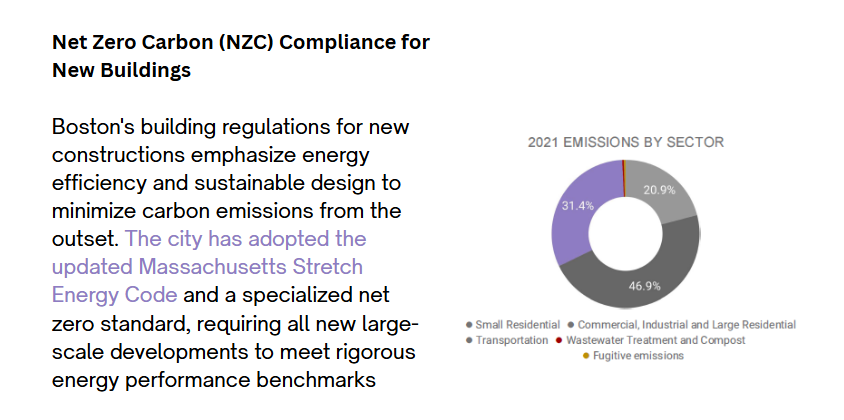
2005-2021 City of Boston Greenhouse Gas Inventory
Key Requirements for NZC in New Buildings
To meet Boston’s new performance standards, developers must implement the following:
- High-Performance Design: New buildings must incorporate efficient heating and cooling strategies, superior insulation, and minimize energy demand. The Passive House Institute U.S. (PHIUS) framework is an effective one to use.
- Electrification: New buildings need to electrify heating, cooling, and all systems transitioning away from oil, gas and fossil fuel-based alternatives so that eventually they can be ready to tap into a clean net zero electrical grid.
- Onsite Renewable Energy or Renewable Energy Procurement: Whenever feasible, new developments must integrate solar panels, geothermal heating, and other renewable energy systems. In cases where onsite renewables are not feasible, developers may purchase Renewable Energy Certificates (RECs).
- Embodied Carbon Reporting: Small and Large Projects will be required to report on embodied carbon, which is the carbon emitted from construction of a building and the manufacturing of its materials. Large Projects will also be required to conduct an embodied CO2e emissions life cycle assessment analysis.
- Carbon Offsetting: Once a building is constructed and operational, emissions from operations will be tracked through the city’s Building Emissions Reduction and Disclosure Ordinance (BERDO, explained a bit later).
Challenges for New Buildings
While Boston’s Net Zero Carbon goals are ambitious and necessary, implementation presents real-world hurdles for developers:
- Higher Upfront Costs: Meeting NZC standards can increase construction expenses, particularly for smaller developments with fewer units to offset consulting, compliance, energy modeling, testing and additional construction costs.
- Electricity Costs & Grid Dependence: While electrification is required, the current power grid still relies heavily on fossil fuels, raising concerns about long-term cost-effectiveness of electrifying now when 90% of our grid today is derived from fossil fuels.
- Urban Density Constraints: In dense city environments, solar panel installation may be limited by roof space and building equipment, geothermal is expensive requiring deep excavation so most likely project will need to purchase Renewable Energy Credits (RECs) for compliance.
Net Zero Carbon Compliance for Existing Buildings & “BERDO”
Since a significant portion of Boston’s emissions comes from older buildings, retrofitting and efficiency improvements are essential. The city’s Building Emissions Reduction and Disclosure Ordinance (BERDO) mandates that existing structures progressively reduce emissions to meet net zero goals.
Compliance Requirements:
- Energy Benchmarking and Reporting: Owners of large buildings over 20,000 square feet must report annual energy and water usage to help the city track progress on carbon emissions.
- Phased Emissions Reductions: Buildings must adhere to specific carbon reduction targets at five-year intervals, culminating in full compliance by 2050.
- Electrification and Energy Efficiency Upgrades: Property owners are encouraged to replace fossil fuel heating systems with electric alternatives, enhance insulation, and install smart energy management systems.
- Renewable Energy Adoption: Owners must transition to renewable electricity sources or participate in city-run clean energy programs.
Challenges for Existing Buildings:
- Cost of Retrofitting: Significant investments are required to transition older buildings to energy-efficient systems, making compliance more difficult.
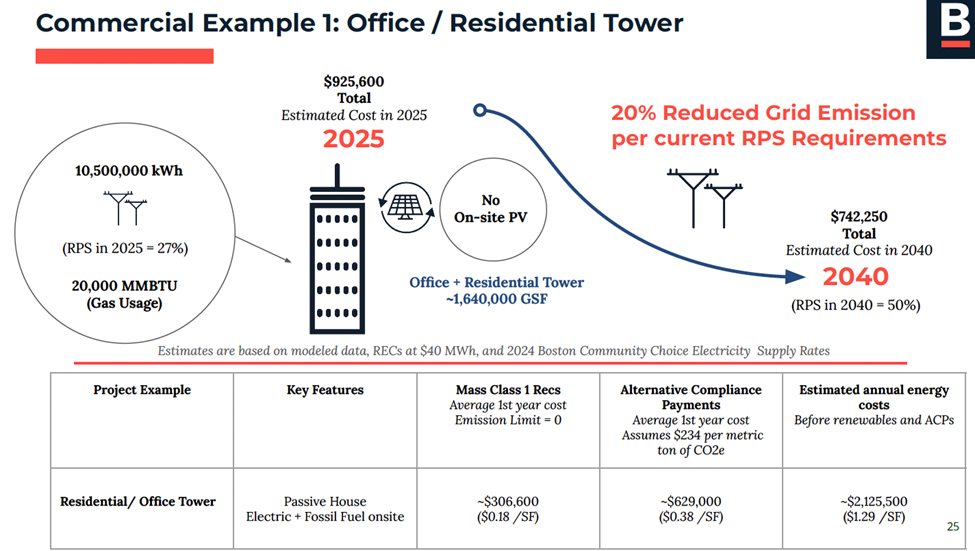
- BERDO Compliance Costs: All existing buildings will be required to offset their carbon emissions by purchasing RECs or contributing to approved sustainability programs. The compliance premium varies widely: Newly constructed PHIUS certified affordable housing units: $0 to $220 per unit annually. New Commercial PHIUS certified high-rise buildings: $0.18–$0.38 per square foot. Older inefficient high-rise buildings: Up to $0.80 per square foot
Market Impact & The Case for Incentives
While certain sectors like lab buildings, hospitals, and general manufacturing have extended timelines to meet net zero requirements, commercial and residential property owners must navigate increased construction costs and compliance complexities. With downtown office vacancies at 18% and availability at nearly 23%, these policies could further impact investment decisions and property valuations. Some form of financial relief or incentives may be necessary to ensure sustainable development while balancing economic feasibility in Boston’s evolving real estate market.
Boston is making bold moves toward a Net Zero future and that future will be shaped by how we design, develop, and retrofit our buildings today. As developers, we sit at the intersection of innovation and implementation. At ZETA InSite, we believe in facing complexity head-on with strategy, collaboration, and transparency.
Curious how we’re putting sustainability into practice on real projects?
See how we are implementing high-performance strategies across our developments.